

Quick answer: the formulas that settle it
The rule most decorators use is 100–150 bulbs per foot of tree height — so a 6ft (1.8m) tree takes roughly 600–900 fairy lights, and a 7ft (2.1m) tree about 700–1,050. For houses, you don't guess: measure the linear metres of roofline, gutters and fences you want lit, then add 10–15% for swag and corners. Cluster lights change the maths completely — their packed density means you need about half the bulb count for the same glow.
Below are the exact formulas for trees, rooflines and garden wrapping, plus the density looks, the power reality check and the mistakes that waste money. Everything here works with the strands in our Christmas lights range — and the full buying-side detail lives in our Christmas Lights Guide.
The tree formula: bulbs per foot
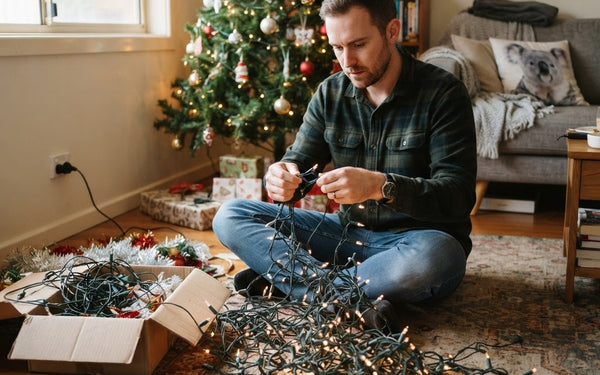
Tree lighting maths starts with height. Take your tree's height in feet, multiply by 100 for a clean medium coverage, or by 150 if you want the rich, editorial look you see in styled shoots. That gives you your total bulb count. Then check how many bulbs are on each strand you're buying (a standard fairy strand is 10m/100 bulbs) and divide.
One honest note: the per-foot rule was built around classic fairy lights. If you're using cluster lights — those dense firecracker-style strands with bulbs stacked along the full length — the same visual comes from roughly half the bulbs, because every centimetre is already packed with light. More on that below.
| Tree Height | Medium Look (100/ft) | Rich Look (150/ft) | Using Cluster Lights |
|---|---|---|---|
| 4ft (1.2m) | 400 bulbs | 600 bulbs | ~200–300 |
| 5ft (1.5m) | 500 bulbs | 750 bulbs | ~250–375 |
| 6ft (1.8m) | 600 bulbs | 900 bulbs | ~300–450 |
| 7ft (2.1m) | 700 bulbs | 1,050 bulbs | ~350–525 |
| 8ft (2.4m) | 800 bulbs | 1,200 bulbs | ~400–600 |
For the full tree-dressing method — where those lights go, and how baubles layer over them — see Christmas Tree Decoration Ideas.
Density: pick your look before you buy
The bulb count isn't just "more is better" — it's a design choice. Three looks, three budgets:
| Look | Bulbs per Foot | What It Says | Best With |
|---|---|---|---|
| Sparse & sculptural | ~75 | Branches, ornaments and gaps do the talking | Native/stylish themes, minimal palettes |
| Classic medium | 100 | The balanced family tree most homes love | Traditional red-and-gold themes |
| Rich & editorial | 150+ | Glow-first; lights are the decoration | Feature trees, dark-foliage PE trees |
If this is your first proper tree, land on medium. You can always add a strand next weekend — you can't easily un-buy the crowded look.
Wrapping maths: trunks, columns and stakes
Garden wrapping uses a spacing rule, not a bulb count. Hold your strand spacing at 5–10cm between wraps for a lush look — tighter for feature trunks, looser for long fence runs.
Measuring a wrap in four steps
- Measure the trunk's circumference — a typical 2m pencil pine is about 30–40cm around.
- Multiply by your wrap count. Wraps = height ÷ spacing. A 2m trunk at 7.5cm spacing = ~27 wraps; at 40cm circumference that's about 11m of strand.
- One 10m strand covers one good trunk. Budget one strand per major trunk or column, and link via the manufacturer's connectable limit.
- Check IP rating outdoors. Wrapped trunks take rain — use IP44 minimum, and solar for anything far from a powerpoint.
For paths and garden beds, the maths is simpler still: solar stakes and solar stake lights go one per 50–80cm of edge, and their solar range needs no cord budgeting at all. Rope light edging runs about one rope light reel per 8–10m of path.
The house: measuring rooflines and gutters
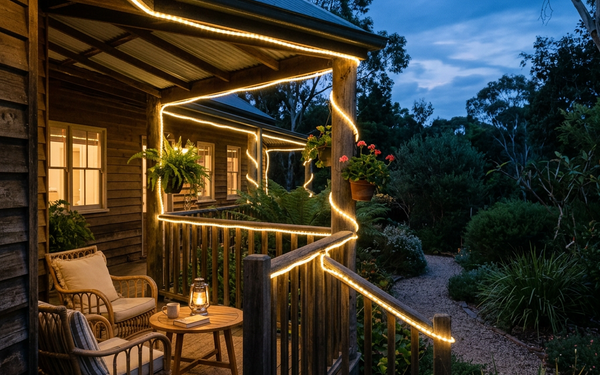
Houses are a tape-measure job, not a guess. Walk the perimeter and measure the linear metres of roofline, gutter, railing or fence you want lit, then add 10–15% for swag depth, droop and corners. A 20m roofline wants 22–23m of lighting; a full average single-storey frontage usually lands between 30 and 45 linear metres once gutters and eaves are included.
Where the strands go is its own discipline — tile lips, Colorbond magnetic clips and gutter hooks all have rules, and they're covered in How to Attach Christmas Lights to a Roof. The short version: buy your hooks and clips in the same order as the lights, not after.
Icicle lights change the roofline maths in your favour: you measure width only, and the drops do the visual work — our LED icicle lights and solar icicle lights both come in fixed-width runs that snap straight onto gutters.
Light type changes the count
This is where most people overbuy. Four common strand types, four different bulb budgets:
| Strand Type | Bulb Density | Relative Count | Best Job |
|---|---|---|---|
| Fairy lights | ~10cm between bulbs | The 100–150/ft baseline | Trees, anything needing wrap |
| Cluster lights | Bulbs stacked along full length | ~Half the fairy count | Maximum glow, minimum strands |
| Net lights | Grid mesh | Area, not linear — one net per bush | Hedges, bushes, walls |
| Icicle lights | Top cord + hanging drops | Width only | Gutters, eaves, fences |
Practical pairing: net lights on the front hedges, icicles on the gutter, cluster strands on the tree. That's a full house lit with fewer total strands than all-fairy — and the 2D and 3D motifs cover feature walls without any maths at all.
The power and cost reality check
Modern LED strands have killed the old "lights melt the power bill" fear. At Australian energy prices around $0.35/kWh, a full tree of LEDs (say 1,000 bulbs at roughly 2–3.6W per 100) costs under $5 for an entire season of six-hour evenings. The real limits are physical, not financial:
Quick tips
- Respect the connectable limit. Every strand states how many can link end-to-end — usually 3–6. It's an electrical rule, not a suggestion.
- Buy RCM-marked lights only. The Regulatory Compliance Mark is the legal requirement for plug-in lighting sold in Australia.
- One circuit per outlet. Spread your runs across multiple outlets rather than chaining everything off one.
- Go battery for far-from-power spots. Battery LED strands light mantels and windows no cord can reach.
- Mix solar in freely. Solar strands add zero load — the sun pays that bill.
For the deep safety detail — transformers, IP ratings, ELV systems and what the compliance marks mean — the electric lights safety guide covers it properly, and the LED switch guide has the full cost maths.
Before buying, ask: does my display need to glow, or does it need to be seen from the street? The answer changes your bulb count by 40%. Glow (the tree visible through the window, the verandah intimate) rewards density on a small area. Street impact rewards spread — more surfaces covered, fewer bulbs per surface. Buy for the one you actually want, and you'll never feel short-changed in December.
Keep reading
How to Set Up Christmas Lights Outdoors: Australian Guide How to Attach Christmas Lights to a Roof (Tile & Colorbond) LED Christmas Lights: Why Make the Switch This SeasonHow many lights do I need? FAQs
How many lights do I need for a 6ft Christmas tree?
A 6ft (1.8m) tree takes 600–900 fairy-light bulbs — the classic medium look lands at 600, the rich editorial look at 900. With cluster lights, plan on roughly 300–450 for the same effect, since their bulbs run the full length of the strand.
How many lights for a 7ft or 2.1-metre tree?
A 7ft tree wants 700–1,050 fairy bulbs depending on how dense you like the glow. That's about seven to ten standard 10m/100-bulb strands connected within the manufacturer's linkable limit, or roughly half that count in cluster strands.
How many lights do I need for my house roofline?
Measure the linear metres of roofline, gutter or fence you want lit and add 10–15% for swag and corners. A typical single-storey frontage lands between 30 and 45 linear metres total once gutters and eaves are included — so start with three to four 10m strands and link within the stated limit.
Do I need fewer cluster lights than fairy lights?
Yes — roughly half. Fairy lights space bulbs about 10cm apart along the strand, while cluster lights stack bulbs along the entire length. The packed density means a 6ft tree that takes 600–900 fairy bulbs only needs about 300–450 cluster bulbs for the same richness.
Can a Christmas tree have too many lights?
Practically, yes — past about 150 bulbs per foot the glow washes out your ornaments and the tree reads as a light source rather than a decorated tree. There's also a hard electrical ceiling: never exceed the number of strands the manufacturer states can be connected end-to-end, usually three to six.
What do Christmas lights cost to run in Australia?
A full tree of LED lights — around 1,000 bulbs — costs under $5 for an entire season at typical Australian energy prices near $0.35/kWh, running six hours a night. LED strands draw roughly 2–3.6W per 100 bulbs; the old incandescent equivalents drew many times more.
What spacing should I use when wrapping trunks and stakes?
Hold 5–10cm between spiral wraps for a lush look — tighter for feature trunks, looser along long fence runs. A 2m trunk with 30–40cm circumference takes about one standard 10m strand at 7.5cm spacing, which makes strand budgeting for the garden simple.
Are icicle lights or fairy lights better for gutters?
For gutters, icicle lights are more efficient: you buy width only and the hanging drops supply the depth for free. Fairy lights work too but need deliberate swag to look full, which takes extra length — add the 10–15% overage to your measurement if you go that way.