

Quick answer: outdoor weatherproofing and transformer safety
Setting up outdoor Christmas lights safely in Australian summer weather requires selecting IP65-rated lights for exposed rooflines and garden runs vulnerable to heavy afternoon downpours. Low-voltage transformers step household power down to 24–31V and must remain indoors or protected inside an IP54 enclosure raised off damp ground. Always verify sets carry the regulatory compliance mark and test every string on flat ground prior to ladder installation.
Planning Your Outdoor Display
Every great outdoor display starts on paper, not on a ladder. Walk your property and pick your anchor points: the roofline and gutters, verandah posts, a pergola, brick boundary fences, and any feature trees or palms. These are the surfaces that carry lights well in Australian homes — and planning them as a set stops the "one more string" tangle that kills most installs.

Measure the runs you want to cover and add 10–15% slack for dips, corners and cable routing back to power. There's nothing worse than being 2 metres short at the last gutter — so measure twice, buy once. And pick a palette before you shop: consistent warm white across icicle, fairy and net lights reads as designer; a mixed bag of whites looks accidental. Most decorators standardise on 2700K warm white, then add one accent colour if they want sparkle.
- Check for the RCM mark. Every set of mains-powered Christmas lights sold legally in Australia carries the Regulatory Compliance Mark — a triangle with a tick — proving compliance with AS/NZS standards. No mark, no buy.
- Extra-low voltage is your friend. Quality outdoor sets step 240V household power down to 24–31V through a transformer, which is what makes them safe to handle on a ladder.
- Never use nails, screws or staples. They pierce cable insulation and create shock paths. Plastic gutter clips, fascia hooks and cable ties do the same job with zero damage.
- Ladder rule of 4:1. One metre out from the wall for every four metres of height, on firm ground — and use a fibreglass or timber ladder anywhere near power.
Understanding IP Ratings for Australian Conditions
The IP (Ingress Protection) rating on your lights tells you what weather they can actually handle — and in an Australian summer, this matters more than any overseas guide admits. IP44 protects against splashing water from any direction: fine under eaves and covered verandahs. IP65 is dust-tight and rated for low-pressure water jets — the spec you want for fully exposed rooflines and fences that cop December thunderstorms.
One rating most people miss: the transformer. Most plugpack transformers are IP20 — indoor-rated only. Plug them in inside, or seal them in an IP54 weatherproof box mounted off the ground outside. A transformer left in a puddle is the number-one cause of tripped safety switches on rainy nights.
The Tools That Make It Easy
You don't need much, and none of it should make holes. UV-stabilised plastic gutter clips snap onto the gutter lip and hold strings taut — space them every 30–50 cm so cables don't sag in storm winds. Fascia hooks screw into timber fascia (the one exception to no-screws — they're designed for it and reusable every year). Brick clips grip mortar lines without drilling. Cable ties secure runs to posts and branches, and a set of outdoor-rated extension leads gets power where it needs to go.
- Test every string on the ground before it goes up. Finding a dead section at the top of a ladder is a special kind of Christmas misery.
- Start at the power point and work outward — you'll never be left with an unpluggable cable end.
- Keep joins elevated in weatherproof boxes, never lying in the garden or on paving where water pools.
- A timer on the power point saves electricity and means the display runs without you remembering a switch.
Powering the Display: Mains, Solar and Battery
For mains sets, the golden rule is simple: transformer indoors (or in a sealed IP54 box), joins elevated and boxed, and one dedicated outdoor power point per major run. For solar lights, Australian summers are a gift — most panels need 6–8 hours of direct sun, so mount them north-facing and clear of shade from eaves and foliage. A well-placed solar string in full Brisbane or Sydney sun will run reliably all December.
Battery lights are the quiet achievers: zero cabling, perfect for wreaths, garlands and fence pickets far from power. Modern sets run weeks on one set of batteries, and many carry timers built in.
Step by Step: The Install
- Test everything on the ground. Unroll each string, power it up, and confirm every section lights before anything leaves the ground.
- Map the runs. Lay strings along the surfaces they'll cover, with the female end pointing away from power, so you can see exactly where each run starts and finishes.
- Attach clips first, lights second. Click gutter clips or fascia hooks into position along the run before you climb — you'll halve your time on the ladder.
- Work from power outward. Connect at the point, walk the string into place, and secure as you go rather than hanging loose cable in the wind.
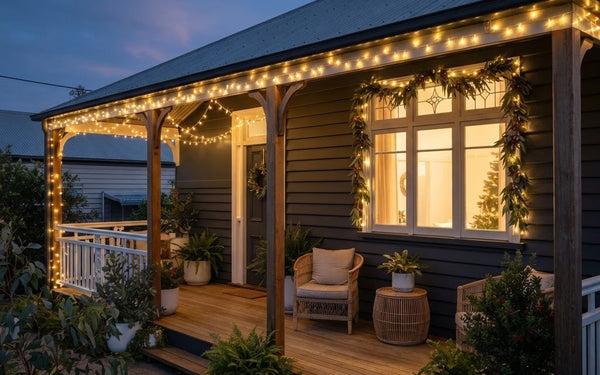
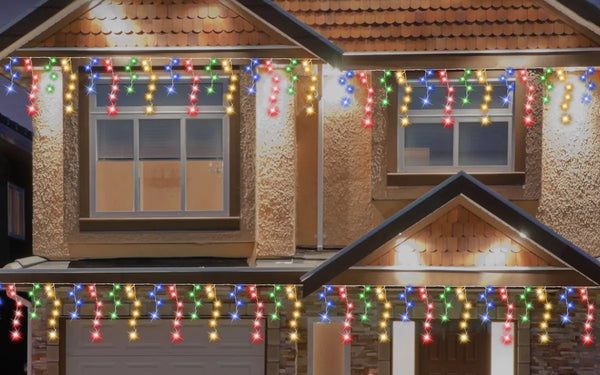
- Rooflines and eaves: icicle and string lights follow the gutter line; keep the cable in the clips, not stretched tight — slack survives storms, tension snaps clips.
- Verandahs and posts: wrap or spiral string lights around posts, or run them along the beam for a clean straight effect.
- Trees and palms: wrap trunks in a spiral, spacing evenly, and let foliage support the cable — never nail into a living tree.
- Set the timer. Most displays look best from dusk; a 6-hour timer from sunset keeps energy use sane and bulbs cooler.
Weathering an Australian Summer
Heat, UV and sudden storms are what actually kill outdoor light sets — not time. Keep these habits and one set will last many Decembers: inspect cable jackets for UV cracking before each season, re-tension clips after the first big wind, and check that every outdoor join is still boxed and elevated after each storm. When December thunderstorms roll through, a timer or switch indoors means you can kill the display without going outside.
If your safety switch trips when it rains, don't reset and forget it — that's moisture telling you exactly where a join isn't sealed. Find it, dry it, box it.
Takedown and Storage
The display comes down easier than it went up if you reverse the process: unplug, then remove strings section by section, winding each string around your elbow or a storage reel as you go. The step that decides whether next December is a joy or an afternoon of untangling: dry everything before it's packed away. Lay strings out for a day in the shade, then store them in sealed containers with any transformers — cool, dry and out of sunlight. Moisture packed away in a box is how sets corrode in storage.
Christmas World's outdoor lighting range covers icicle, fairy, net, rope and solar lights in IP-rated outdoor specs — plus the clips, timers and weatherproof accessories that make the install painless.
Frequently Asked Questions — Outdoor Christmas Lights
What IP rating do outdoor Christmas lights need in Australia?
IP44 (splash-proof) is the minimum for outdoor use and suits sheltered spots under eaves and verandahs. For fully exposed rooflines, fences and garden features that cop storm rain, choose IP65 — dust-tight and rated for water jets.
Can I plug my light transformer into an outdoor power socket?
Most plugpack transformers are IP20 — indoor-rated only. Plug them in inside, or house them in an IP54 weatherproof box mounted off the ground outside. A transformer sitting in the weather will trip your safety switch and shorten the set's life.
How do I know my lights meet Australian safety standards?
Look for the RCM symbol — a triangle containing a tick — on the packaging and transformer. It certifies the set complies with AS/NZS electrical safety standards. Christmas World only stocks RCM-compliant lights.
How many metres of lights do I need for my roofline?
Measure the linear metres of gutter or fascia you want to cover, then add 10–15% for slack, dips and corners. So a 20-metre roofline wants roughly 22–23 metres of string lights.
Are solar Christmas lights reliable in Australia?
Very — Australian summer sun is ideal. Give the panel 6–8 hours of direct, unshaded light a day (north-facing, clear of eaves) and a quality solar set will run every night through December.
How do I hang lights on gutters without causing damage?
Use UV-stabilised plastic gutter clips that snap onto the gutter lip, or fascia hooks along timber fascia boards. Both hold strings firmly without nails, screws or staples, and they're reusable every year.
Is it safe to leave LED lights on all night in summer heat?
Low-voltage LED sets run cool and draw very little power, so they're safe — but a timer switching the display off around 11pm saves electricity and extends the set's lifespan.
Why do my lights trip the safety switch when it rains?
Rain is getting into an unsealed join, damaged cable or an exposed transformer. Check that every outdoor connection sits elevated inside an IP54 weatherproof box, and replace any cable with a cracked jacket.