

Quick answer: display planning and LED power costs
Creating an impactful holiday feature across living spaces and gardens relies on establishing a single unified theme before laying out indoor and outdoor lighting zones. Modern outdoor-rated LED sets draw merely 3 to 6 watts per 500 bulbs, keeping total electrical running costs to a couple of dollars throughout December. Ensure all exterior connections are elevated inside weatherproof boxes to prevent unexpected safety switch trips during summer storms.
Plan the Display Before You Buy a Single Light
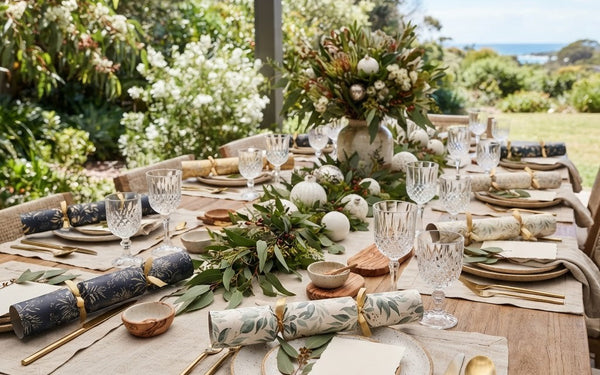
The best Christmas displays — the ones cars slow down for — aren't the most expensive ones. They're the most planned ones. Before anything goes up, decide on one cohesive theme and stick to it: classic red and green, coastal Aussie white and gold, native botanical with eucalyptus tones, or full vibrant multicolour. One theme carried through the front yard, the entry and the living room reads as designer; five competing colours reads as a clearance sale.

Then map your zones: indoor focal points first (the tree, the mantel, the table), then the verandah and alfresco areas where you'll actually spend Christmas evening, and finally the street-facing elements — roofline, front garden, entry — for curb appeal. And because this is an Australian December, plan for 35°C days, UV index 11+ and the odd afternoon thunderstorm: every product that goes outside needs to be rated for it. That pre-check of lights, leads, power points and safety switches saves December tears.
Indoor Displays, Room by Room
The Tree Is the Anchor
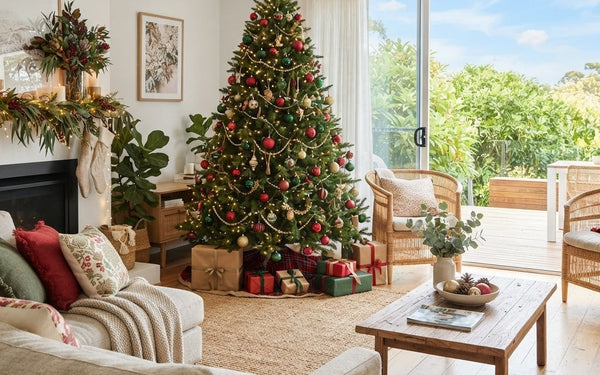
Everything indoors revolves around the tree. Layer your lighting rather than draping it: fairy or cluster lights woven deep into the branches, not just wrapped around the outside, is what gives that professional depth. A good rule of thumb is 100 LEDs per 30cm of tree height — so a 7ft (2.1m) tree wants around 700 LEDs for a balanced glow, or 1,000+ for the dense, professional twinkle.
Mantels, Sideboards and Tables
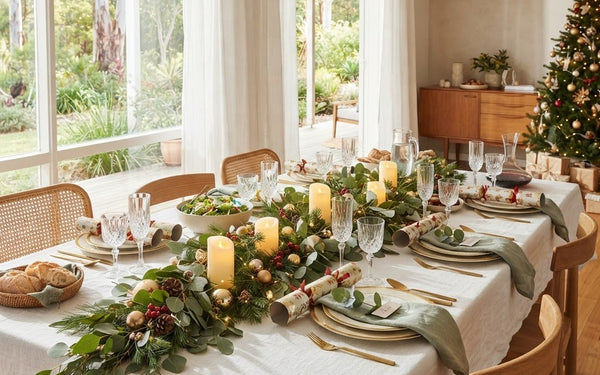
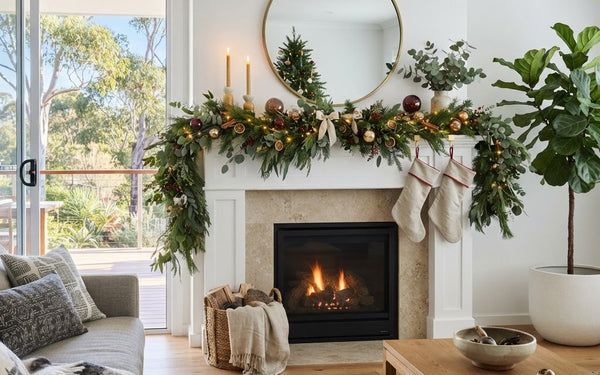
Once the tree is lit, dress the horizontal surfaces: a garland along the mantel with a few warm-white picks woven in, a sideboard vignette with nutcrackers or a small light-up house, and a Christmas lunch table styled with battery-operated LED copper-wire lights through a centrepiece (no cords across the tablecloth). Windows love candle bridges and small battery lanterns — safe around curtains, no flame, and they make the street-facing windows glow at night.
- Warm white everywhere except one deliberate colour accent — the single most reliable "designer" trick.
- Cluster lights on the tree, icicles on the eaves: each light type has a job, don't mix them on the same surface.
- Battery-operated LEDs for tables and windows mean zero cords and zero heat in the summer heat.
- Style the mantel and the tree in the same hour so you can balance the two against each other.
Verandah, Patio and Alfresco Displays
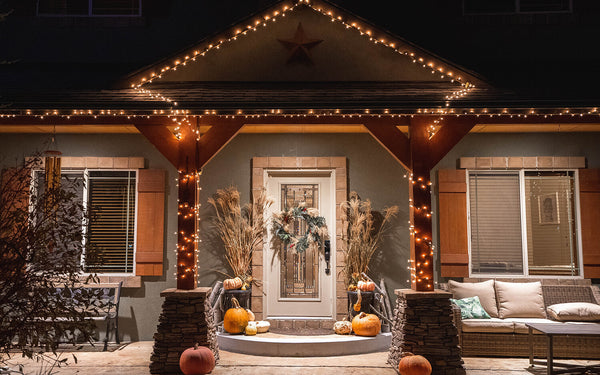
The verandah is where Australian Christmases actually happen — the long Christmas Eve dinner, the Boxing Day drinks. Frame the space with festoon or icicle lights along the beams and eaves, then add surface-level ambience: solar lanterns along the balustrade, an LED wreath on the entry door, and UV-proof greenery on the outdoor table that won't bleach in a week of sun. Because alfresco zones are sheltered, IP44-rated lights are fine here — which opens up more styling options than the fully exposed front lawn.
Front Yard and Garden Displays
Statement Pieces on the Ground
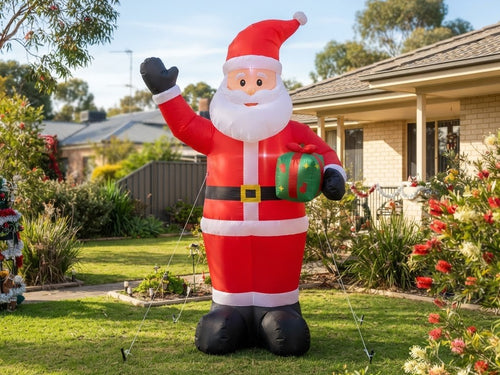
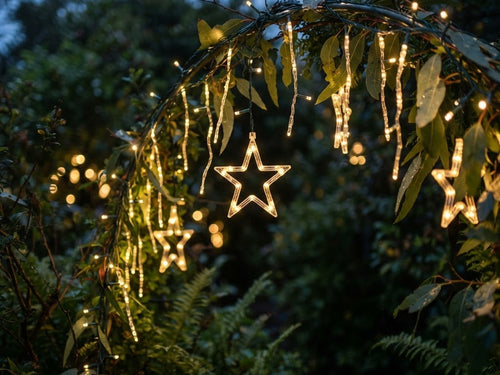
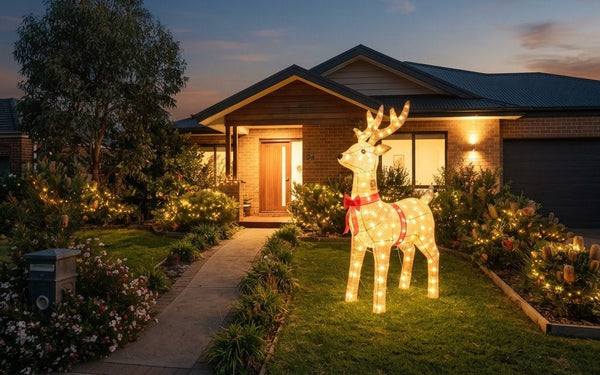
3D and 2D light displays — reindeer, stars, motifs — are the anchor pieces of a front yard. Position two or three large items (a pair of reindeer flanking the path, a light-up star on the lawn) and fill around them; a couple of large pieces beats twenty small ones every time. Inflatables work beautifully here too — just anchor them properly: heavy-duty plastic tent pegs, nylon guy ropes at 45°, and sandbags or water weights hidden inside the base. A southerly buster will test every anchor you skip.
Wrap What's Already Growing
Australian gardens are full of free display structure: palm trunks wrapped in a clean spiral, frangipanis and hedges in net lights, gum trees traced with cluster lights. Net lights are the fastest way to dress a hedge flat — one throw, instant coverage.
The most Australian display idea there is: spiral your clothesline with rope or fairy lights from the base of each pole to the top of the hoist, and the humble Hills Hoist becomes a giant glowing cone-shaped Christmas tree in the middle of the backyard. Use outdoor-rated, IP65 lights, cable-tie the runs to the line arms every 40cm, and you've got a statement piece visible from across the neighbourhood.
Rooflines and Gutters: Colorbond vs Tiles
The roofline makes or breaks street appeal. How you attach lights depends entirely on your roof material — this is where overseas guides get Australian homes badly wrong:
For full icicle coverage along the roofline, plan on 40–60 LEDs per metre — a typical 15-metre house front needs 600–900 drop LEDs for the proper curtain effect.
Australian Electrical Safety: The Non-Negotiables
Every light set that plugs into mains power in Australia must carry the RCM mark (the triangle with a tick) certifying it against AS/NZS 60598.2.20. Quality sets step the power down to extra-low voltage — 24V or 31V — via the transformer, so the strings themselves can't deliver a dangerous shock even if chewed by a pet or damaged in a storm. Check for the mark before you buy anything, keep transformers indoors or sealed in an IP54+ weatherproof box, and run outdoor displays through a safety switch (RCD).
And match the IP rating to the position: IP44 for sheltered eaves and verandahs; IP65 or IP67 for anything on an open lawn or wrapped in a tree that cops rain, sprinklers and storm runoff directly.
The Pro's Decorating Math
- Tree: ~100 LEDs per 30cm of height — 7ft tree = 700 LEDs standard, 1,000+ for dense.
- Roofline strings: 15–20 LEDs per metre; icicles need 40–60 drops per metre for full coverage.
- Hedges and shrubs: one net light per square metre of face.
- Power: a 500-LED LED string draws just 3.6–6W — 1,000 LEDs run all December for well under a dollar in electricity at typical tariffs.
- Pack-down: wrap each string around a piece of cardboard, label by zone, store dark and cool — the display reassembles in half the time next year.
Christmas World curates its entire display range for Australian conditions — RCM-compliant lighting, UV-stable materials, and the clips and anchors that fit Colorbond, tile and brick homes. Everything in this guide is in-store and online.
Frequently Asked Questions — Christmas Display Ideas
What IP rating do I need for outdoor Christmas lights in Australia?
IP44 minimum for sheltered eaves and verandahs; IP65 or IP67 for anything exposed to rain, sprinklers or storm runoff on an open lawn or wrapped in a tree.
How do I hang Christmas lights on a Colorbond roof without drilling?
Use rubber-coated magnetic light clips or vinyl foldback clips along the roof edge. They hold firm in wind without puncturing the sheet metal, scratching the paint or voiding the roof warranty.
What does the RCM mark mean on Christmas lights?
The Regulatory Compliance Mark — the tick inside a triangle — proves the lights meet Australian safety standard AS/NZS 60598.2.20 and are legally approved for sale in Australia. No mark, don't buy.
How many fairy lights do I need for a 7ft Christmas tree?
Plan for 500–700 LEDs for a balanced glow (roughly 50–70 metres of standard string), or 1,000+ LEDs for a dense, professional twinkle. Cluster lights achieve the dense look with fewer metres.
Can outdoor Christmas light transformers be left out in the rain?
No. Transformers are typically rated IP20–IP44 and must stay plugged in indoors or be housed in an IP54-rated weatherproof electrical box, elevated off the ground with drip loops on every lead.
How much electricity do LED Christmas lights use over December?
Very little: a 500-LED string draws only 3–6 watts, so running 1,000 LEDs for 6 hours a night across the whole month costs well under a dollar to about $2 at typical Australian tariffs.
How do I anchor inflatables and light displays against summer winds?
Heavy-duty plastic tent pegs, nylon guy ropes at 45° angles, and sandbags or water weights hidden inside the base. Take inflatables down when a storm front is forecast — anchors keep displays stable, not invincible.
How do I attach lights to terracotta roof tiles safely?
Use plastic tile-lip clips that snap onto the tile edge without lifting or forcing tiles. Never pry tiles up or fix into them — cracked terracotta means an expensive roofer visit.