

Quick answer: choosing an artificial Christmas tree
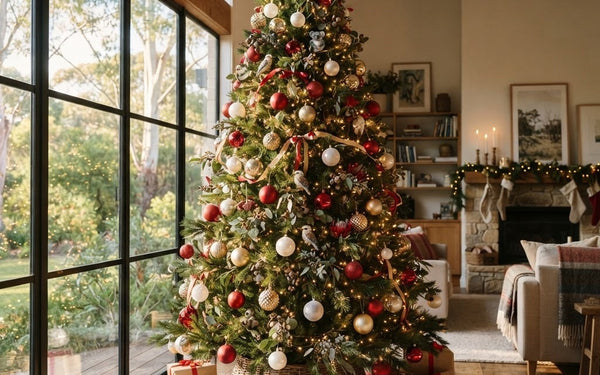
The best artificial Christmas tree for most Australian homes is a PE (injection-moulded) tree with a dense tip count, built on a hinged frame, pre-lit with warm white LEDs. PE tips look and feel like real fir needles, hinged branches fold down in minutes instead of hooking in one by one, and pre-lit saves hours of untangling. If budget matters more than realism, a PVC tree still looks lovely once fluffed and decorated. Always match tree height to your ceiling, leaving at least 30cm for a topper.
Why Australian Families Choose Artificial Trees
Australia celebrates Christmas in summer, which changes the tree conversation completely. A real fir indoors in December heat needs daily watering, drops needles on the presents, and only lasts a few weeks. An artificial tree goes up in under an hour, stays flawless through the whole silly season, and packs away flat in January for next year.
The economics stack up too. A good quality tree costs about the same as two or three real trees but lasts five to ten seasons or more, so the per-year cost drops every Christmas. They're also the practical choice for anyone with allergies or sensitivities to pollen and sap, and for homes where nobody wants to water a tree between the beach and the Christmas ham.
How to Choose an Artificial Christmas Tree
Realism Starts With the Needle Type
The single biggest quality difference between cheap and premium trees is the needle material. PVC needles are cut from flat sheets of plastic film: they're soft, affordable and give that classic fluffy fullness when fluffed well. PE needles are injection-moulded from plastic resin into three-dimensional branch tips that copy real fir and pine sprigs, right down to the way each needle curves.

Most realistic trees combine both: PE tips at the ends of branches where eyes and hands land, PVC filler deeper inside the tree for body and fullness at a sensible price. If realism is the goal, look for a high PE tip count and avoid trees described only as "hologram" or "tinsel" PVC, which catch light beautifully but read as decorative rather than natural.
Pre-Lit or Unlit: What Suits Your Setup
Pre-lit trees arrive with lights already woven through the branches. The good ones use warm white LEDs on low-voltage systems with section-by-section wiring, so a single failed bulb never blacks out the whole tree. Buying pre-lit means one box, one setup, and a professional light distribution you'd struggle to match yourself, because the lights are placed deep in the tree where they create depth.

Unlit trees suit decorators who enjoy the ritual of lighting the tree, or anyone who already owns a large set of lights. They cost less up front and never tie you to a built-in lighting style. If you go unlit, budget roughly 100 lights per 30cm of tree height, and our Christmas lights range covers every size. For a full walkthrough of both approaches, see our guide on how to put lights on a Christmas tree.
Hinged Frames Beat Hooked Branches
Check how branches attach before you buy. Hooked trees have colour-coded branches you insert individually into a centre pole, which can take an hour and a small dictionary of curse words. Hinged trees have branches permanently attached to the frame on metal hinges: you just fold them down, fluff, and you're done in a fraction of the time. Hinged frames also pack away as one unit, so nothing goes missing in storage.

Pull-up or "instant" trees are the third option: the whole tree fans out of an umbrella-style frame in one motion. They're brilliant for small apartments and quick setups, with a slightly less natural silhouette. Our hinged Christmas tree care guide covers setup and fluffing in detail if you'd like the full walkthrough.
Match the Size to Your Room, Not the Showroom
Tree height is the mistake we see most often. Measure your ceiling first, then subtract about 30cm for a tree topper and stand, and remember the stand and skirt sit on top of your floor coverings. A 1.8m tree suits most Australian living rooms with 2.4m standard ceilings; 2.1m and up needs a void or raked ceiling. Width matters just as much: slim or pencil trees carry full presence into units and verandahs without eating the walkway. We've written a complete Australian Christmas tree sizing guide with room-by-room recommendations.
Check the Tip Count and Density
Manufacturers list a tip count: the total number of branch tips on the tree. Higher tip counts mean a denser tree that hides the centre pole and holds heavy baubles without sagging. A useful rule of thumb is that more tips with a mix of PE and PVC always beats fewer tips of pure PVC at the same price. Density also protects your decorations: sparse branches let ornaments swing and clatter, while dense branches grip each hook securely.
Comparing PE, PVC and Fibre-Optic Trees
Fibre-optic trees twinkle with shifting colour rather than mimicking nature: see our fibre optic Christmas trees for that light-show style. For the snow-covered look, our guide to flocked vs frosted vs snowy trees explains which finish suits your palette.
Quick Tips for Buying the Right Tree
- Buy the best frame you can afford: branches and hinges outlive trends.
- Choose warm white LEDs for a natural glow; cool white suits icy, modern palettes.
- Check the manufacturer's fluffing guidance: a cheap tree fluffed well beats a premium tree fluffed badly.
- Measure your storage spot before the box arrives: 2.4m trees need a tall cupboard or a dedicated tub.
- Pair the tree with a quality stand or base so it never leans by Christmas Eve.
Setting Up Your Artificial Christmas Tree: Simple Steps
From Box to Centre Stage
- Stage the stand on a level floor and lock in the centre pole.
- Fold down the hinged branches section by section, bottom to top.
- Fluff each branch upward and outward, splitting tips so light passes through.
- Shape the tree, stepping back every few minutes to check the silhouette.
- Place your tree skirt, hide the cord, and dress the tree once the lights are on.
Storing Your Tree the Australian Way
January heat is hard on stored trees, so pack yours in a cool, dry spot out of direct sun. A proper tree storage bag or its original box stops dust and UV fading; standing it upright rather than lying flat protects the branch memory so next year's setup is even faster. Keep lights, stands and spare globes together in one labelled tub so December-you thanks January-you. Our tree accessories range has everything from bases to spare parts.
The Christmas World Standard
Our artificial Christmas trees range is curated the way we'd furnish our own homes: realistic tips, sturdy hinged frames, and pre-lit options that light perfectly out of the box. Explore slim, white and snowy styles across the wider Christmas trees collection, add a tree skirt for the finishing touch, and enjoy free shipping on orders over $149 across Australia.
Shop Artificial Trees Shop All TreesFrequently Asked Questions — Artificial Christmas Trees
What is the most realistic type of artificial Christmas tree?
Trees with PE injection-moulded tips are the most realistic. The tips are moulded from real branch samples, so they copy the curve, colour and layering of natural fir and pine. Trees that combine PE outer tips with PVC inner filler offer the best balance of realism, fullness and price.
Are pre-lit Christmas trees worth it in Australia?
Yes, for most families. Pre-lit trees save setup time, distribute light more evenly than hand-stringing, and modern LED systems run cool in summer heat while costing only cents per night to run. They cost more up front, but they remove the biggest annual hassle of tree setup.
How long do artificial Christmas trees last?
A well-made tree lasts five to ten seasons, and premium frames often longer. Longevity comes down to frame quality, how gently the tree is packed away, and whether it's stored cool, dry and out of direct sunlight between seasons.
What size artificial tree should I buy?
Start with your ceiling height and subtract about 30cm for the topper and stand: in most Australian homes with 2.4m ceilings that means a 1.8m to 2.1m tree. Then check floor space for the skirt diameter and walkways around the tree.
How do I make my artificial tree look fuller?
Fluffing is everything. Split each tip upward and outward, work one branch at a time from the inside out, and angle tips toward open spaces. Twenty minutes of proper fluffing transforms a tree from "just unpacked" to showroom quality.
Can I put an artificial tree outside on the verandah?
Only trees rated for outdoor use should live on a verandah. Australian sun is hard on UV-rated anything, so an indoor tree outside will fade, and afternoon storms don't help either. Look for outdoor-rated trees and keep them in a sheltered spot, plugged into an outdoor-safe power point.
How should I store my artificial Christmas tree?
Pack it into a tree storage bag or its original box, store it upright in a cool, dry, shaded spot, and keep it clear of garage heat and direct sun. Label the tub with the tree size so next year's setup is a five-minute decision instead of a treasure hunt.
What is the difference between flocked, frosted and snowy trees?
All three describe snow-effect finishes. Flocked trees carry thick, full snow coverage; frosted trees have a light dusting concentrated on the tips; snowy sits between the two. Our guide to flocked vs frosted vs snowy Christmas trees explains how to style each look.