

Quick answer: Slim & Pencil Christmas Trees for Small Spaces
A slim Christmas tree has a base diameter of roughly 75 to 90 cm, about half the width of a standard tree. A pencil Christmas tree is even narrower at 40 to 60 cm across, designed to slot into tight corners, hallways and narrow verandahs. Both give you full height from 4 to 9 ft without the footprint. For Australian apartments, units and small living rooms, Christmas World recommends a slim or pencil tree so you get the festive impact without losing walkway space.
What Is a Slim Christmas Tree?
A slim Christmas tree is an artificial tree with a narrower-than-standard base diameter. While a typical 7ft tree averages 130 to 150 cm across, a slim version of the same height measures roughly 75 to 90 cm. The branch length is shorter, but the tip count and shape remain full. You sacrifice floor space, not fullness.
Slim trees come in hinged designs for easy setup and are available pre-lit or unlit. They suit bedrooms, tight living rooms and alongside furniture where a standard tree would dominate.
What Is a Pencil Christmas Tree?
A pencil Christmas tree is the narrowest profile available, typically 40 to 60 cm in base diameter. The name comes from the slim, upright silhouette. Pencil trees fit where even a slim tree cannot: hallways, entryways, between furniture and small balconies. They range from 4ft tabletop models up to 9ft floor-standing designs.
Despite the narrow footprint, pencil trees still carry a worthwhile tip count. A 7ft pencil tree typically holds 400 to 600 tips, enough to look full from the front while staying shallow in depth.

Slim vs Pencil vs Standard: Size Comparison
Here is how the three profiles compare at a typical 7ft height:
Choosing the Right Width for Your Space
Before buying, measure the spot where the tree will stand. You need the tree width, plus at least 40 cm of clearance on each side for decorations and walkway access.
Christmas World's rule: measure the available width first, then subtract 80 cm (40 cm each side) to find your maximum tree diameter. A 120 cm space means a tree no wider than 80 cm, right in the slim range.
When placing a slim or pencil tree in a corner, keep the tree base flush against both walls to avoid damage to skirting or paint. Leave 10 cm between the outermost branches and each wall so lights and decorations sit evenly. A pencil tree in a corner needs as little as 60 cm from the corner point — the base sits tight and the branches flair forward gently.

Where Slim Trees Shine in Australian Homes
Australian homes increasingly trend toward compact living. Apartments in Sydney, Melbourne and Brisbane rarely have the generous living rooms of decades past. Slim and pencil trees solve the space problem without sacrificing the Christmas centrepiece.
- Apartment living rooms: a slim 7ft tree gives full height in a fraction of the floor space.
- Bedrooms: a pencil tree beside the dresser adds festive mood to the smallest room.
- Hallways and entryways: a pencil tree greets guests without blocking the path.
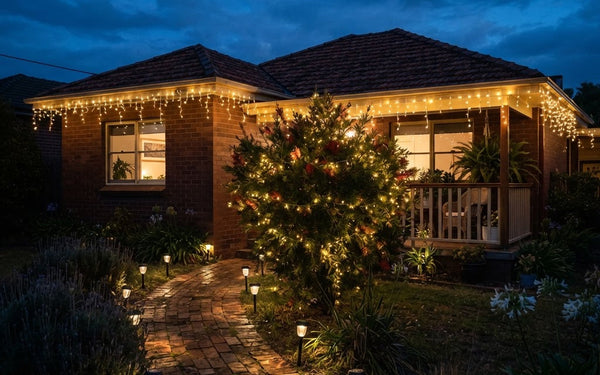
- Narrow verandahs: a slim tree sits outside without dominating the entrance.
- Shop and storefront displays: pencil trees create impact in tight retail footprints.
You can browse our full artificial tree range or narrow further with white slim trees and snowy and flocked slim trees for a different look in the same compact profile.
Pre-Lit Slim Trees: Worth the Convenience?
Pre-lit slim trees are popular in Australia because they save time and guarantee even light distribution on a narrow profile. The built-in lights are professionally strung from trunk to tip, so there are no dark gaps on the shorter branches. Most modern pre-lit slim trees use warm white LEDs, which run cool and draw minimal power.
An unlit slim tree costs less upfront and lets you choose colour, density and whether to mix fairy lights or cluster lights. The trade-off is time: wrapping a slim 7ft tree takes roughly 30 to 45 minutes versus 15 for a pre-lit model. For most Australian homes, Christmas World recommends pre-lit for convenience, especially on a narrow tree where even light distribution matters.

How to Decorate a Slim or Pencil Tree
A narrow tree carries fewer decorations than a full one, and that is a good thing. Less is more with slim and pencil profiles. Here is Christmas World's approach:
- Light first. Even a pre-lit tree benefits from a strand of LED fairy lights to connect the branch tips. Use our density guideline: 100 to 150 bulbs per foot of height.
- Choose smaller baubles. Standard baubles in 6 to 8 cm sizes suit slim and pencil trees better than large ornaments, which can overwhelm the narrow profile.
- Keep depth shallow. Hang baubles close to the branches rather than dangling them outward, keeping the silhouette narrow.
- Top it simply. A slim tree topper or star suits the upright profile better than wide, heavy toppers that look unbalanced.
- Add a skirt that fits. Slim trees need a smaller tree skirt, so choose a 90 cm or narrower base to match.
Find Your Slim or Pencil Tree
Shop our range of artificial Christmas trees, with slim and pencil profiles for every Australian home.
Free shipping over $199, Australia wideWhen the season wraps, slim and pencil trees are easy to store. Their narrow profile means a storage bag takes up less room than a standard tree. Pair your tree with a sturdy stand designed for the narrower base.
Frequently Asked Questions — Slim & Pencil Christmas Trees
What is the difference between a slim and a pencil Christmas tree?
A slim Christmas tree has a base diameter of roughly 75 to 90 cm, while a pencil tree measures 40 to 60 cm across. Slim trees are narrower than standard but still have a substantial shape. Pencil trees are the narrowest option, tall and upright, designed for the tightest spaces like hallways and corners.
How narrow is a slim Christmas tree?
A slim Christmas tree typically measures 75 to 90 cm in base diameter at the widest point. This is roughly half the width of a standard tree, which averages 130 to 150 cm. The exact width varies by height: a 6ft slim tree may be 70 cm, while a 9ft slim tree can reach 90 cm.
What size slim Christmas tree should I buy?
Start with your ceiling height. Allow at least 15 cm clearance between the top of the tree and the ceiling, plus room for a topper. For standard Australian ceilings (2.4 m), a 7ft slim tree fits perfectly. For apartments with lower ceilings, a 6ft or 5ft slim tree is ideal. A pencil tree works at any height since the footprint stays narrow.
Can a slim Christmas tree fit in a corner?
Yes. Slim and pencil trees are designed for tight spots. A pencil tree needs as little as 50 cm of corner space, perfect for a hallway turn or the corner of a bedroom. A slim tree needs roughly 90 cm of width including clearance for decorations. Always measure your corner before buying.
Are pre-lit slim Christmas trees worth it?
For most Australian homes, yes. A pre-lit slim tree saves setup time and guarantees even light distribution on a narrow profile. Pre-lit trees cost a bit more upfront but include lights worth $100 to $200 if bought separately, professionally strung from trunk to tip. An unlit slim tree lets you customise colour and density, but takes roughly 30 to 45 minutes to wrap with lights.
How much space does a pencil Christmas tree need?
A pencil Christmas tree needs as little as 50 cm by 50 cm of floor space. For the full tree plus clearance, plan for about 80 cm by 80 cm to allow for decorations and a tree skirt. Most doorways in Australian homes are 80 cm or wider, so a pencil tree fits through easily.
How do you decorate a slim or pencil tree?
Keep it simple. Use smaller baubles (6 to 8 cm), hang them close to the branch rather than dangling outward, and avoid heavy or wide ornaments. A single set of fairy lights or the built-in pre-lit glow is usually enough, as slim trees look best when the light density matches their compact shape. A lightweight topper fits the upright profile.
Can you put a slim Christmas tree on a verandah or balcony?
Yes, with the right conditions. An artificial slim or pencil tree works well on a covered verandah or balcony. Secure the stand firmly to prevent wind tipping, choose a sheltered spot away from direct rain, and use lights rated for the conditions. We recommend a wide-base stand for stability outdoors.