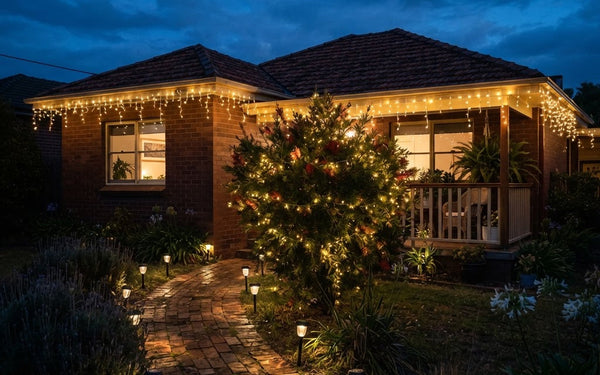


Quick Answer: What Are Cluster Lights and Why Choose Them?
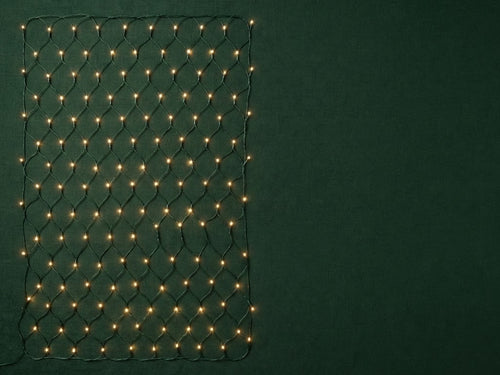
Cluster lights are the densest Christmas light strand you can buy. Instead of evenly spaced bulbs along a wire, hundreds of tiny LEDs sit roughly 2.5 cm apart, often on both sides of the cable, so the whole strand glows as one continuous ribbon of light. The result is a richer sparkle than standard fairy lights can produce, with no visible gaps between bulbs. Christmas World recommends Christmas Cluster Lights for Australian homes that want maximum impact on a single tree, in a window, or wrapped around an outdoor trunk, They are LED (so running cost is under $5 for the season), and you need roughly half as many bulbs as a classic fairy-light wrap on the same tree.
What Are Cluster Lights?
A cluster light strand is a single string of micro-LED bulbs mounted with very tight spacing. Where traditional LED Fairy Lights sit every 10 cm or so along a wire, cluster lights pack in their LEDs at roughly 2.5 cm apart, and many designs place bulbs on both the top and bottom of the cable so the strand throws light in every direction. You will sometimes see them sold as "micro cluster" or "rice light" strands. They are always LED; the tiny bulb size is what makes the high density possible without a heavy power draw.
Each LED is moulded into a continuous wire with a PVC or rubber sleeve protecting the join — no socket-and-bulb system to come loose. Most of the cluster lights in our Christmas Lights range ship with a low-voltage transformer and eight lighting modes, the same controller system you will recognise from our other LED Christmas Lights.

Why Cluster Lights Create Maximum Sparkle
The reason cluster lights look fuller than anything else comes down to one number: bulbs per metre. A typical fairy-light strand gives you around 100 LEDs across a 10 m run. A cluster strand of the same length can pack in 480 or more. Our rule for Australian homes: if you have ever looked at a dressed tree and felt the lights were "stringy" or gappy, the fix is density, not strand count. Cluster lights are the only strand style we stock that delivers a true continuous-glow finish on a single wrap, and they pay off up high too — one length on a verandah roofline or fence reads as a full line of light from the street.
Cluster Lights vs Fairy Lights: What Is the Difference?
The two get confused more than any other Christmas light style. Both are LED, both run on the same low-voltage transformer, and both twist around a tree in the same way. The difference is purely the spacing and number of bulbs on the wire.
If you already love the classic fairy-light sparkle and just want to push it further, you get the same effect with a richer finish by swapping to cluster strands. For Australian homes, mixing Christmas Cluster Lights on the tree with LED Fairy Lights along a mantel is our go-to combination.
How Many Cluster Lights Do You Need?
Cluster lights already pack in so many bulbs that you need fewer of them to hit the same visual density. The density rule from our lighting guide is simple: cluster lights need about half the classic fairy-light count for the same look.
For a full look with cluster lights, aim for the upper end of each band. For something understated, the lower end still reads as dense because the bulbs are so tightly spaced. Layering clusters over a pre-lit tree? Halve the count again to avoid hot spots where two light sources compete on the same branch.
Warm White, Cool White, or Multicolour?
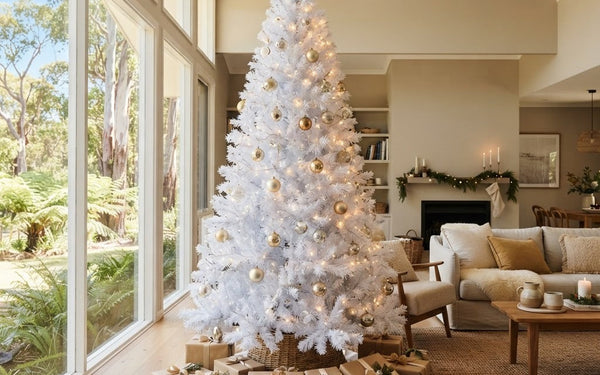
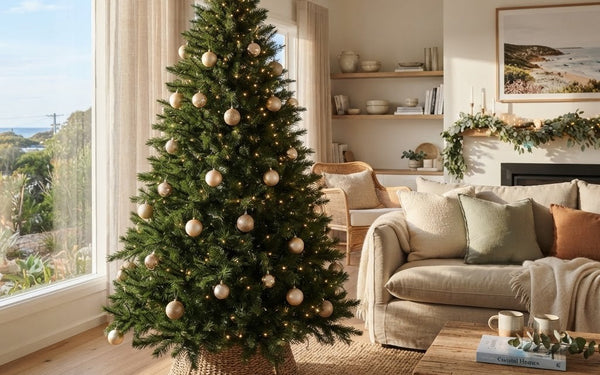
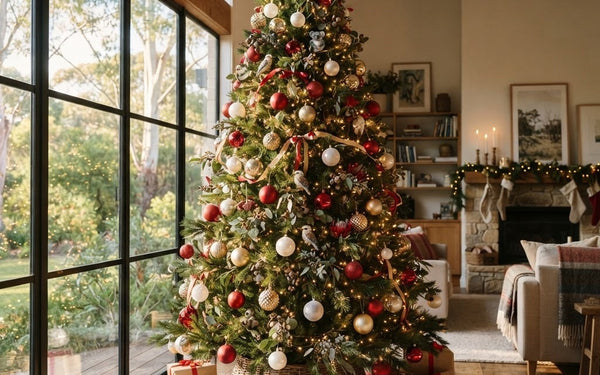
Most cluster light strands come in three finishes: warm white (around 2,700 K, the candlelight tone), cool white (around 6,000 K, bluer and brighter), and multicolour. Christmas World recommends warm white for trees and any feature you sit near, because the colour temperature flatters timber, foliage, and gift wrap. Cool white works well as a second strand for outdoor wraps where you want contrast against warm window light. Multicolour is the family-room pick, especially with kids, where the colour mix keeps the tree visually busy in the best way.
Our Christmas Cluster Lights range also includes mixed-mode strands with eight effect patterns and all three colours on one controller.
Solar Cluster Lights for Outside
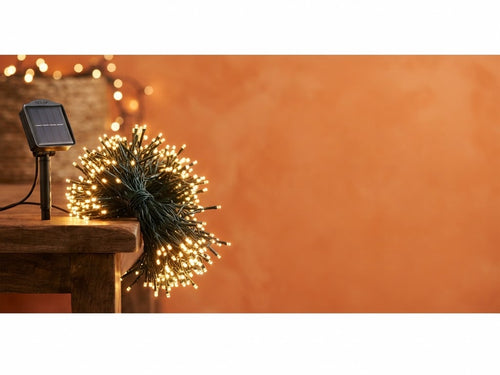
Solar cluster lights combine the dense sparkle of a cluster strand with a self-contained solar panel, so there is no need to run a transformer lead out to a garden bed or fence. They sit alongside our Solar Cluster Lights range and the wider All Solar selection.
Solar clusters are designed for Australian summer: the panel charges through the day and the strand comes on at dusk with a light sensor, running 6–8 hours per charge. Strand counts per set are usually a touch lower than the mains versions, so plan for one extra set if you want the same fullness on a wide outdoor tree.

How to Put Cluster Lights on Your Christmas Tree
Wrapping a tree in cluster lights uses the same technique as fairy lights. The only difference is that the dense strand hides the wire more easily, so cable direction is less fussy.
1. Start from the bottom of the tree
- Plug the strand in at the base so you can see the light direction.
- Begin wrapping around the lowest branches, working from the trunk out along each branch and back.
- Keep a consistent tension so the strand wraps without bunching.
2. Work upwards in a spiral
- Move up one branch level at a time, spiralling around the trunk as you go.
- Take the strand out along two or three branches and back at each level before spiralling up.
- Use Hooks & Clips to hold the first few wraps if the branches are smooth or slippery.
3. Step back and check for dark spots
- Take three or four steps back every 60 cm of wrapping and check the tree from across the room.
- Re-adjust any under-lit branches before moving higher; cluster strands make gaps obvious.

Quick Tips for Cluster Lights
- Test every strand on the floor before you start wrapping; a dead strand halfway up a tree is a frustrating untangle.
- Keep the controller box near the trunk, not at the plug end, so you can change modes without crawling under the tree.
- For outdoor wraps, secure the solar panel in full sun with a clip from our Lighting Accessories range; even an hour of shade shortens the run.
Ready to Light Up Your Tree?
Browse the full Christmas Cluster Lights range, or explore Solar Cluster Lights for outdoor projects. Christmas World has all eight NSW stores stocked through to New Year, plus Australia-wide delivery with free shipping over $149.
Shop Christmas Cluster Lights Shop Solar Cluster LightsFree shipping Australia-wide on orders over $149
Caring for and Storing Your Cluster Lights
- Always unplug by the transformer end, not by pulling the strand; tiny bulb stems can stress at the join.
- Let outdoor strands dry completely before coiling; salt air and humidity are harder on micro-LED joins than on larger bulbs.
- Coil loosely rather than wrapping tightly; a tight wrap stresses the dense bulb spacing more than it does fairy lights.
- Use a storage reel or the original cardboard sleeve to keep tangles out; both fit in our Light Storage range.
Frequently Asked Questions — Cluster Lights
What are cluster lights?
Cluster lights are an LED Christmas light strand with very tightly spaced bulbs, usually around 2.5 cm apart, often on both sides of the wire. The close spacing means the strand reads as one continuous ribbon of light rather than a row of separate points, giving you a denser, fuller sparkle than standard fairy lights.
How many cluster lights do I need for a 6 ft tree?
For a 6 ft / 1.8 m tree, Christmas World recommends 300–450 cluster-light bulbs. That is about half the classic fairy-light count for the same tree, because the tighter bulb spacing on a cluster strand gives you the same visual density with fewer bulbs.
Can cluster lights be used outdoors?
Yes, if they are rated for outdoor use. Most of our mains cluster lights are rated for covered outdoor applications like verandahs and pergolas. For exposed garden or tree-trunk runs, look for IP-rated strands or use our Solar Cluster Lights, which are designed for full Australian summer exposure.
What is the difference between cluster lights and fairy lights?
Bulb spacing and density. Fairy lights sit roughly 10 cm apart on one side of the wire; cluster lights sit roughly 2.5 cm apart, often on both sides. Cluster lights give a continuous glow; fairy lights give a more traditional twinkle of separate points.
Do cluster lights use a lot of electricity?
No. Cluster lights are LED, so the draw is roughly 2–3.6 W per 100 bulbs. Over the full season (about 45 evenings at 6 hours per night, which is 270 hours), a 700-bulb display would use around 3.8–6.8 kWh. At a rough energy price of $0.35 per kWh, that is roughly $1.32–$2.38 for the whole season — comfortably under $5.
Can I connect multiple sets of cluster lights together?
Yes. Many of our cluster strands support end-to-end connectability, so you can daisy-chain sets up to the manufacturer's stated maximum. Always check the maximum run length on the product page; over-loading the connectable limit is the most common cause of strand failure.
How long do cluster lights last?
LED cluster lights have a rated lifespan of tens of thousands of hours, so with proper care a strand will last many Australian Christmas seasons. The most common failure point is the controller box or joins near the plug, not the bulbs themselves.
What colour cluster lights are best for a Christmas tree?
Warm white is the safe pick for most trees; the colour temperature flatters timber, foliage, and gift wrap. Cool white reads brighter and more modern when paired with a silver or icy tree. Multicolour is the classic for family-room trees, especially with children.