

Wrapping outdoor trees with Christmas lights takes roughly 5–10 metres of light string per metre of tree height, spaced 7–10 cm apart on the trunk and branches. Use weatherproof LED fairy lights rated IP44 or higher, plastic tree clips rather than tape or nails, and a spiral wrap from base to canopy for an even, professional glow that holds up to an Australian summer.
Choosing the Right Lights for Wrapping Trees
The best Christmas lights for wrapping outdoor trees share three qualities: they are LED, weatherproof, and flexible enough to spiral tightly around branches. LED Christmas lights draw only 2–3.6 watts per 100 bulbs, stay cool to the touch even after hours of running, and last upward of 25,000 hours — critical when they are pressed against living bark through a six-week display season.
The main styles suited to tree wrapping are:
- LED fairy lights — fine wire or thin-cable strings with closely spaced micro-LEDs. The go-to for trunk and branch spiralling because they bend tight and disappear into the foliage.
- Cluster lights — denser than fairy lights, with bulbs arranged in a diamond pattern rather than a single line. They produce a fuller glow on bare deciduous trunks where there is no foliage to diffuse the light.
- Net lights — pre-formed grids that drape over shrubs and small trees. Useful for hedges and low foliage, but less practical for tall trunks.
- Rope lights — LEDs encased in a flexible plastic tube. Great for clean, structured trunk lines, but the tube diameter limits how tight a spiral you can achieve.
- Battery-operated lights — for trees far from a power point. Shorter run times, so choose a set with a timer to conserve battery life.
Whatever style you choose, check for an IP44 rating at minimum — this means the lights are protected against solid objects and splashing water. For trees fully exposed to rain and irrigation spray, look for IP65-rated lights, which are dust-tight and sealed against water jets. All electrical Christmas lights sold in Australia must carry the Regulatory Compliance Mark (RCM) under the Electrical Equipment Safety System, confirming the product meets AS/NZS standards.

How Many Lights Do You Need?
For most Australian gardens, our general rule is 5–10 metres of light string per metre of tree height. A 3-metre deciduous tree needs roughly 15–30 metres of lights; a 6-metre gum needs 30–60 metres. The range depends on how dense you want the wrap — closer spacing gives a brighter, more solid look.
To calculate more precisely:
- Trunk: Measure the trunk circumference at chest height (roughly 1.5 m). A typical garden tree runs 30–80 cm, meaning roughly 1–2.5 metres of light string per spiral wrap. With 7–10 cm spacing, a 3-metre trunk needs about 30–43 spirals, which is 30–108 metres of lights depending on trunk girth.
- Branches: Add 2–4 metres of lights per major branch, wrapping out about halfway along each limb.
- Canopy: Drape or weave 5–10 metres through the upper branches for a starry effect.
A simpler approach most decorators use: start with a 20-metre string for a small tree (under 2 m), 30–50 metres for a medium tree (2–5 m), and 50–100 metres for a large tree (5 m and up). You can always add more strings, and connectable LED strings make chaining runs straightforward.
How to Wrap a Deciduous Tree in Lights
Deciduous trees — maples, oaks, jacarandas, crepe myrtles — are the easiest outdoor trees to wrap because their bare winter branches give you a clean framework to work with. Australian deciduous trees lose their leaves in late autumn to winter, which aligns perfectly with the Christmas display season.
Wrapping Palm Trees with Christmas Lights
Palm trees offer a distinctly Australian Christmas display opportunity. Their clean, straight trunks and architectural fronds create a dramatic vertical light canvas. The technique differs from wrapping deciduous trees because palms have no side branches — the light goes on the trunk and, optionally, along the frond stems.
Trunk wrapping: Use fairy lights or rope lights and spiral up the trunk in the same pattern as a deciduous tree. Palm trunks are uniform in diameter, which makes the spacing easier to keep even. For a tall palm (4–8 m), you may need 30–60 metres of lights for the trunk alone.
Frond lighting: Drape light strings along the underside of each frond stem, securing with soft ties or clips. Do not nail or staple into the crown — this can introduce disease. Solar lights are popular for palms because many grow in front yards without a nearby power point. Solar cluster lights and solar rope lights both work well, though the solar panel needs direct sun exposure to charge properly through the day.
One tip worth noting: if your palm has sharp frond bases or thorns (some date palms do), wear thick gloves and wrap the trunk only, leaving the fronds unlit. The effect is still striking, and it saves a lot of scratched-up hands.

Securing Lights Without Damaging the Tree
The single most important rule of wrapping trees: never use anything that pierces the bark. Nails, staples, and screws create wounds that let in disease and pests. Duct tape and zip ties left on too long can girdle the tree as it grows, cutting off sap flow.
Christmas World recommends the following attachments for tree wrapping:
- Plastic tree clips — small clips designed to grip light strings against bark. Available in lighting accessories, they hold firmly and release cleanly.
- Green cable ties — UV-resistant ties in 100–150 mm length. Snip and remove at takedown; never reuse ones that have gone brittle from sun exposure.
- Rubber-coated wire ties — gentle on bark and reusable. Good for securing rope lights to palm trunks where extra rigidity is needed.
At takedown, remove all ties and clips promptly. A tree that is wrapped for six weeks is fine, but ties left into spring can start to constrict growth. Walk the tree after removing lights and check for any ties you may have missed.

Powering Your Tree Lights
Three power options work for outdoor tree lights, each with trade-offs:
For mains-powered displays, always use an outdoor-rated power point with a residual current device (RCD). Run the cable to the tree at ground level through a weatherproof cable cover and create a drip loop at every connection so water runs off rather than into the plug. AS/NZS 3000 requires all outdoor electrical installations to be RCD-protected.
Solar lights are increasingly popular for tree wrapping in Australia because our long summer daylight hours provide excellent charging. Solar Christmas lights turn on automatically at dusk and run for 6–8 hours. Position the solar panel facing north (in southern Australia) in a spot that gets at least 6 hours of direct sun.
For running costs, LED tree lights are remarkably cheap. A 20-metre string of 200 LEDs draws roughly 4 watts, costing around $0.05 per night at the Australian average electricity rate of roughly $0.35 per kWh for a 6-hour run. You can light a whole row of trees for under $2 a week.
Australian Summer Weather Warning
Summer storms in Australia — southerly busters, electrical storms, and heavy downpours — can strip lights from trees and create electrical hazards. Before a forecast storm, consider switching off and unplugging mains-powered tree lights. Ensure all connections are sealed with weatherproof joiners and elevated off the ground. If you are in a cyclone-prone area (tropical North Queensland, Northern Territory), take tree lights down entirely when a cyclone watch is issued.
Quick Tips for Wrapping Trees
- Start with warm white (2700K) LEDs for a classic, cohesive glow. Mixing warm and cool white on the same tree looks jarring.
- Wrap from the bottom up so the plug end stays at ground level near the power source.
- Space your trunk spirals evenly — 7–10 cm gives a solid band of light without wasting string.
- Test each string before you install it, and again once it is on the tree.
- Use a ladder helper and never work on a tree near overhead power lines.
- Choose solar lights for palms and trees at the end of the block where running an extension lead is impractical.
- Add icicle lights to low-hanging branches for a cascading effect alongside the trunk wrap.
- Take lights down before Australia Day — the longer they stay up, the more the cable ties degrade in UV.
Finishing Touches for Your Outdoor Display
Wrapped trees are often the centrepiece of an outdoor display. Pair them with outdoor decorations and light motifs to build out the full scene. A lit tree next to a simple pathway display or a lit reindeer silhouette creates layered depth. For a narrower budget, even a single-wrapped front-yard tree with a clean trunk spiral looks impressive to neighbours and passers-by.
If you are wrapping multiple trees along a fenceline, vary the heights of the wraps: light the first tree from base to mid-canopy, the second from base to full height, and leave the third as a subtle trunk-only wrap. The variation reads as intentional, not uniform.
Ready to wrap your outdoor trees? Shop fairy lights, cluster lights, and solar tree lights online or in-store at Christmas World.
Free shipping over $149 Australia-wide.
Frequently Asked Questions — Wrapping Trees with Lights
How do I wrap a tree with Christmas lights?
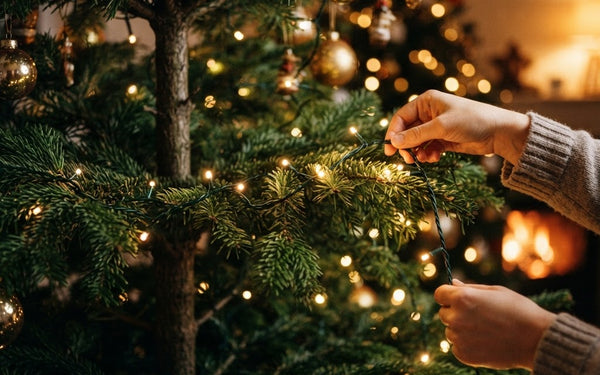
Spiral the light string around the trunk from the base upward, spacing each loop 7–10 cm apart. When you reach the first major branch, wrap out along it and back, then move to the next branch. Use plastic tree clips or green cable ties to secure the string every 30–50 cm. Start with the plug at ground level near your power source.
How many lights do I need to wrap a tree?
Plan for 5–10 metres of light string per metre of tree height. A 3-metre tree needs roughly 15–30 metres of lights; a 6-metre tree needs 30–60 metres. You can calculate more precisely by measuring trunk circumference and counting branches, but the height-based rule gets you close enough for most garden trees.
What are the best lights for wrapping outdoor trees?
LED fairy lights are the most versatile choice because they bend tightly and disappear into the branches. For bare deciduous trunks, cluster lights produce a denser, brighter effect. Net lights work on shrubs and hedges. Choose weatherproof sets rated IP44 or higher, and always check the RCM compliance mark.
Can I wrap a palm tree with Christmas lights?
Yes. Wrap the trunk in the same spiral pattern as a deciduous tree. For frond lighting, drape strings along the underside of each frond stem and secure with soft ties. Do not nail or staple into the crown. Solar lights work well for palms in front yards without a nearby power point.
How do I attach lights to trees without damaging them?
Use plastic tree clips or UV-resistant green cable ties. Never use nails, staples, or screws — they pierce the bark and invite disease. Duct tape and tight zip ties left on too long can girdle the tree. Remove all attachments at takedown and check for any you missed.
Are solar lights good for wrapping trees?
Solar lights are excellent for trees far from a power point. They turn on automatically at dusk and cost nothing to run. Position the solar panel facing north with at least 6 hours of direct sun. On overcast days, expect the lights to be dimmer and run for fewer hours.
How close together should I space the light wraps?
For trunk wraps, space each spiral 7–10 cm apart. This gives a continuous band of light without gaps. For a subtler effect, increase the spacing to 15–20 cm. On branches, wrap evenly along the full length you want lit, then stop — do not bunch the excess at the tip.
How do I protect tree lights in Australian storms?
Use weatherproof connections and create drip loops so water runs off rather than into the plug. Before a forecast severe storm, switch off and unplug mains-powered tree lights. Ensure all connections are off the ground. In cyclone-prone areas, take the lights down entirely when a watch is issued.