

Unboxing and First Setup
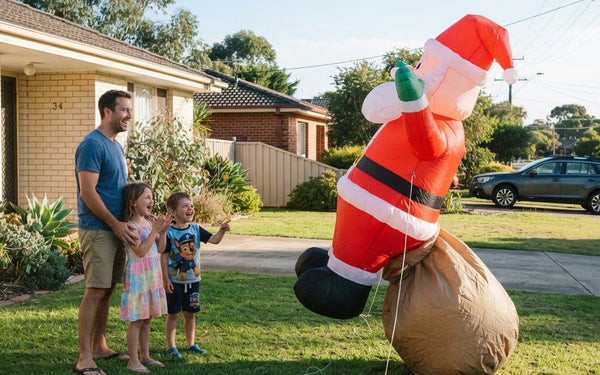
There's a moment every December when the inflatable comes out of the box and the kids are already watching — so let's make the setup the easy part. Before it goes anywhere near the lawn: unroll the fabric completely, check all the anchor loops and tethers are intact, and confirm the transformer carries the RCM mark and an IP44+ rating for outdoor use. Lay it flat in the yard and pick your spot before you power anything up.

Walk the area and clear bindis, sticks, garden stakes and anything sharp — inflatables are tough, but nylon has no chance against a rose bush. Note where your outdoor power point is, because the display has to reach it without a lead stretched across a pathway.
Choosing the Right Spot for an Australian Summer
The best inflatable spot in Australia is a flat, open lawn with afternoon shade — and the three things to avoid are heat, wind tunnels and radiant surfaces. Dark Colorbond fences, tin sheds and brick western walls radiate serious heat on 35°C days; keep at least a metre of clearance so the fabric and fan aren't cooking beside them. Give the base fan a full 360° of airflow — grass clippings, mulch and low garden plants under the air intake choke the motor. And if your yard funnels the summer southerly buster, plan anchoring accordingly, because that wind arrives fast and from a direction you didn't expect.
Powering Up Safely
Inflatables are simple electrical gear — a low-voltage fan running continuously, with cool-touch LEDs inside — but the setup rules matter. Connect through an RCD-protected outdoor power point, keep the transformer and every join inside an elevated weatherproof box (30 cm off the ground, minimum), and put a drip loop in the cord before the plug so rain runs down the cable's low point instead of into the socket. Don't daisy-chain a stack of leads off one outlet; one quality outdoor-rated extension lead per display is the limit.
- Run the cord to the power point BEFORE staking down, so you know the display reaches without stretching.
- Never plug the fan in while the inflatable is folded — let it inflate fully on its own.
- Keep a few spare pegs and zip ties in the shed during display season; one wind event always claims some.
- Timer on the power point means the display runs dusk-to-late without you remembering a switch.
Anchoring: The Part That Actually Matters
Every inflatable that's ever taken flight was under-anchored. The rule is simple: stakes plus tethers, every time. On grass and soil, drive 20–25 cm steel or spiral stakes at a 45-degree angle pointing away from the base — thin plastic pegs pull out in the first decent gust. Attach the tethers at the manufacturer's anchor points and spread them wide; a single tether turns the inflatable into a kite.
- Pavers, concrete and decks: don't penetrate the surface. Use 5–10 kg sandbags attached to the lower anchor loops, or fill the internal weight pockets if your model has them.
- Verandahs and balconies: tie tethers to structural posts or heavy planters — never to a railing that the wind can lever.
- Before every storm warning: deflate, unplug, and lay the inflatable flat or bring it inside. A folded inflatable rides out a storm; an inflated one doesn't.
The Setup, Step by Step
- Clear and check the site — sharp objects out, fan airflow free, power point within reach.
- Lay the inflatable flat and untangle every internal tether so the shape can rise evenly.
- Zip the base closed — the bottom deflation zipper must be fully closed or it will never stand.
- Stake and tether — drive stakes at 45°, attach tethers at the anchor points, leave slight slack.
- Connect power through the RCD-protected point, with joins boxed and elevated, drip loop in place.
- Watch the first full inflation — the shape should rise symmetrically and hold firm. Adjust stakes before the kids arrive.
Troubleshooting: When It Won't Stand Up
Ninety percent of "broken" inflatables are one of three fixable things. Won't inflate: check the base zipper is fully closed and the fan intake isn't blocked by grass or leaves — a choked intake is the most common failure by far. Inflates but leans or collapses: an internal tether has twisted around the fan or an LED wire; unzip, untwist, re-zip. Rises then slumps in heat: the fan is fighting radiant heat from a nearby wall — move the display or create clearance. If the fan runs but nothing happens at all, check power at the transformer before assuming the motor's gone.
Packing Away for Next Year
Takedown is where inflatables are won or lost. Unplug, deflate completely, and — the step that decides its lifespan — let the fabric dry fully before it's folded. January and February humidity is exactly how black mildew ends up sealed inside a nylon box, eating the fabric and the wiring. Once bone dry, fold loosely without creasing the fan housing, roll rather than squash, and store in a sealed tub somewhere cool. Come next December it'll rise like it's new.
Christmas World's inflatable range runs from 1.2 m characters to full 4 m front-yard showpieces — all with IP44-rated outdoor transformers, reinforced fabric, and internal weight pouches, tested for Australian summers.
Complete the Look
Frequently Asked Questions — Christmas Inflatables
How do you stop a Christmas inflatable from blowing away?
Stakes and tethers together: drive 20–25 cm steel or spiral stakes at 45 degrees pointing away from the base, attach tethers at every anchor point, and spread them wide. On hard surfaces use 5–10 kg sandbags instead of stakes.
Can inflatables stay out in Australian summer storms?
Quality inflatables with IP44-rated transformers handle rain, but deflate and secure them — or bring them inside — whenever a severe storm or gale warning is issued. An inflated inflatable in a storm is a liability; a flat one is fine.
Why won't my inflatable stand up properly?
Check three things in order: the base deflation zipper is fully closed, the fan air intake isn't blocked by grass or leaves, and no internal tether has twisted around the fan or LED wiring. One of these three is almost always the cause.
How do I anchor an inflatable on concrete or a deck?
Don't penetrate the surface. Fill the internal weight pouches with sand or gravel, or attach 5–10 kg sandbags to the lower anchor loops. Tethers can also run to heavy planters or structural posts.
Do Christmas inflatables use much electricity?
No. The continuous fan is low-voltage and efficient, and internal LEDs sip power — a typical inflatable costs only a few cents per hour to run. A timer keeps it even lower.
Can I run several inflatables off one extension lead?
Yes if the combined draw stays within the lead's and power board's rating and everything runs through an RCD-protected outlet — but as a rule, one quality outdoor-rated extension lead per display, with no daisy-chaining.
How do I stop my inflatable fading in strong sunlight?
Choose a spot with some mid-day shade during peak UV, keep it a metre clear of radiating walls, and deflating through extreme heatwaves prevents heat stress on the fabric and fan.
How should I store my inflatable so it lasts?
Bone dry before folding — always. Then roll loosely, keep the fan housing uncreased, and store in a sealed tub in a cool room. Damp storage is the number-one killer of inflatables.